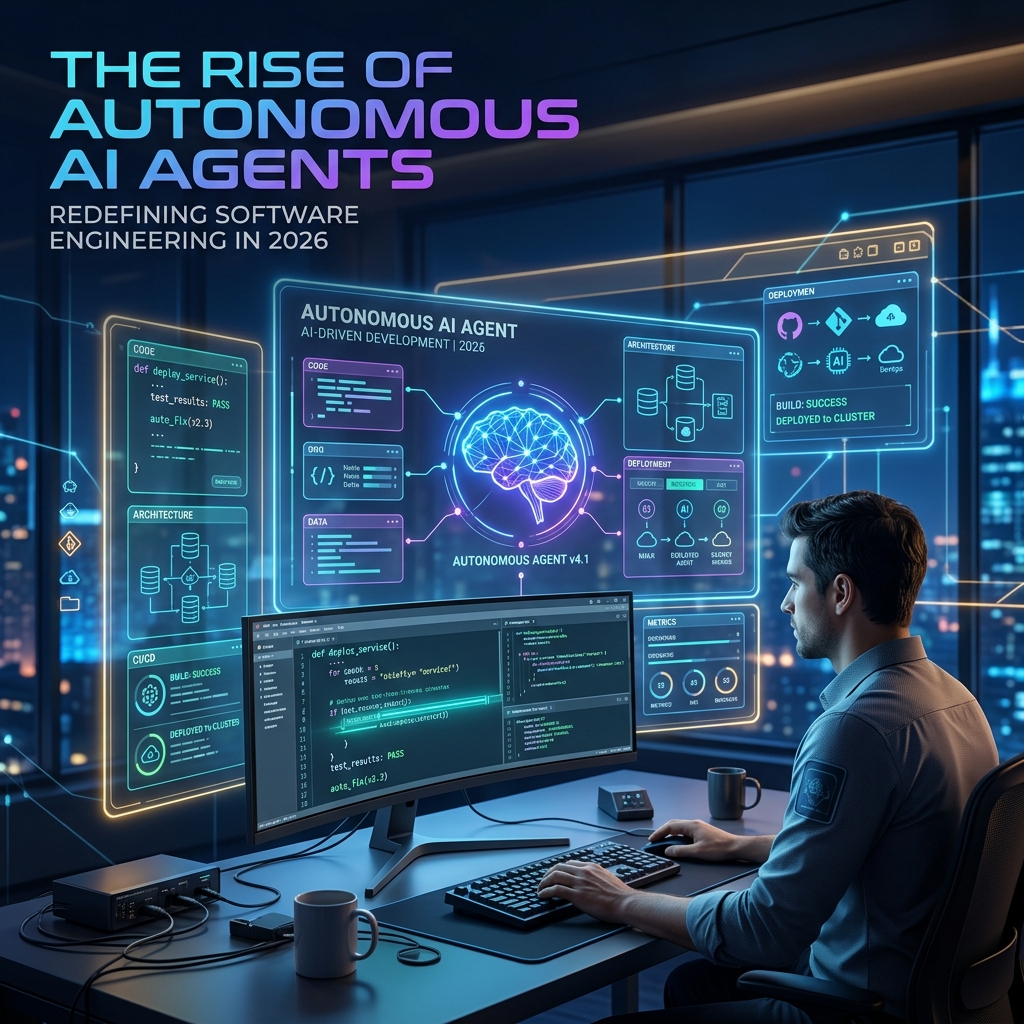
Over the last few years, the role of artificial intelligence in software development has undergone a monumental shift. We have rapidly transitioned from basic code-completion models that predict the next few characters of a function to sophisticated autonomous AI agents capable of executing multi-file refactorings, managing complex debugging sessions, and even orchestrating end-to-end continuous integration pipelines. As we progress through 2026, the discussion is no longer about whether AI will assist developers, but how autonomous AI agents are actively redefining the fundamental nature of the software engineering lifecycle.
The Evolution: From Copilots to Autonomous Agents
To understand the current state of autonomous software engineering, we must examine how we arrived here. The first wave of AI development assistants operated primarily as inline auto-completers. They were reactive, answering single prompts or filling in boilerplate code block-by-block. While useful, they required constant guidance, verification, and manual integration by a human developer.
Today's autonomous AI agents represent a paradigm shift. Unlike their predecessors, these agents are proactive, stateful, and goal-oriented. Equipped with advanced reasoning frameworks, memory stores, and the ability to interact directly with standard development tools, they operate as virtual team members. They can browse codebases, run test suites, analyze errors, and execute multi-step plans with minimal human intervention. This shift from "autocomplete" to "autonomy" is the defining technical breakthrough of this era.
Core Architecture of an AI Development Agent
What makes an AI agent truly autonomous? It is not just the underlying large language model (LLM), but the surrounding orchestration layer that equips the agent with capabilities analogous to a human software engineer. The architecture of a modern AI agent generally consists of four primary pillars:
- Planning & Reasoning: The agent uses advanced prompt engineering techniques—such as Chain-of-Thought (CoT), Tree-of-Thoughts (ToT), or ReAct (Reasoning and Acting)—to decompose high-level user requests into granular, logical steps.
- Tool Integration: An agent is sandboxed but equipped with access to the command line, compilers, linters, Git, and web browsers. This enables it to compile code, run tests, and research documentation in real time.
- Memory Management: Agents maintain both short-term memory (session history) and long-term memory (vector databases of codebase architecture, past bugs, and design patterns) to maintain contextual consistency across large systems.
- Reflective Feedback Loops: Before declaring a task complete, high-quality agents run self-correction cycles. They execute test suites, capture errors, and recursively debug their own implementation until all tests pass.
Real-World Impact: Reshaping the SDLC
The introduction of autonomous agents is impacting every phase of the Software Development Life Cycle (SDLC):
1. Automated Bug Resolution and Maintenance
Legacy codebases often accumulate a large backlog of minor bugs, security warnings, and dependency updates. Human developers are frequently too bottlenecked by feature work to address these issues. Autonomous agents can be deployed directly into issue queues. They can reproduce a reported bug by writing a new unit test, locate the faulty code in the repository, apply the fix, run the tests to confirm resolution, and submit a clean Pull Request (PR)—all in a matter of minutes.
2. Multi-File Code Refactoring
Refactoring code to support a new architecture or API version often requires modifying dozens of files concurrently. Traditional coding assistants struggle with this because of context window limitations. Modern agents, powered by codebase indexers and AST (Abstract Syntax Tree) parsers, can map out dependencies and safely apply contiguous changes across the entire repository while maintaining style consistency.
3. Intelligent Test Generation
Writing comprehensive tests is critical but time-consuming. AI agents can analyze existing source code, identify logical edge cases, and automatically generate robust unit, integration, and end-to-end tests, pushing code coverage close to 100% with minimal manual effort.
A Developer's Sandbox: An Example Agent Workspace
To illustrate how these agents operate, consider an agent tasked with adding a new feature. Below is a conceptual illustration of a tool execution block where an autonomous agent runs a verification cycle on a React page:
// Conceptual representation of an autonomous agent running verification
async function runAgentPipeline(targetIssue) {
  console.log(`[Agent] Analyzing issue: ${targetIssue.id}`);

  // 1. Search the codebase for relevant components
  const components = await codebaseSearch("ProfileForm.jsx");

  // 2. Identify the bug: Missing field validation
  console.log("[Agent] Identified missing validation for phone field.");

  // 3. Make the necessary code modifications
  await editFile(components[0].path, {
    replace: "phone: Yup.string()",
    with: "phone: Yup.string().required(\'Phone number is required\')"
  });

  // 4. Run automated tests to verify the fix
  const testResult = await executeCommand("npm run test");

  if (testResult.status === "PASS") {
    console.log("✅ [Agent] Verification successful! Submitting Pull Request...");
    await gitCommitAndPush("fix: Add phone validation on profile page");
  } else {
    console.log("❌ [Agent] Tests failed. Entering self-correction cycle...");
    await debugErrorLog(testResult.log);
  }
}
Best Practices for Working with AI Agents
As agents become more integrated into software teams, developers must adapt their workflows to maximize their effectiveness. Here are the best practices for collaborating with AI agents:
- Maintain Robust Test Suites: An agent is only as good as the feedback loop it operates in. Detailed, fast, and comprehensive unit tests are the ultimate guardrails for autonomous agents. If a test fails, the agent knows immediately and can correct itself.
- Establish Sandbox Environments: Never run arbitrary agent execution directly on production systems. Always run agents in sandboxed containers or local directories where file writes and shell commands are isolated.
- Enforce Strong Code Review Rules: Treat agent pull requests exactly like those of human interns. Require thorough human code review and automated CI/CD checks before merging any AI-generated PR.
- Keep Code Clean and Modular: Agents perform exceptionally well in highly modular codebases with clear separations of concerns (e.g. Clean Architecture, MVC). Spaghetti code or massive single-file components increase cognitive complexity and lead to context errors.
The Future: Human-Agent Collaboration
A common concern is whether autonomous agents will replace human software engineers. The reality is far more collaborative. Agents excel at tactical, repeatable, and high-velocity tasks: writing boilerplate, refactoring structural patterns, upgrading versions, and expanding test coverage. Human engineers excel at strategic, high-level planning: defining product requirements, architectural design, security modeling, and understanding user experiences.
In the near future, the most successful developers will not be those who write every line of code by hand, but "Developer Orchestrators" who lead teams of specialized AI agents. Developers will define goals, review PRs, and focus on high-impact architecture, while agents handle the heavy lifting of implementation and maintenance.
Conclusion
The rise of autonomous AI agents marks the beginning of a new era in software engineering. By shifting from reactive autocomplete helpers to proactive, stateful collaborators, agents are enabling teams to ship higher-quality software at unprecedented speeds. As developers, the path forward is clear: embrace these tools, build the guardrails to guide them, and step up to the role of software orchestrators. The future of software engineering has arrived, and it is autonomous.