Introduction & The Problem
In today's fast-paced digital economy, acquiring leads is only half the battle; the real challenge lies in efficiently qualifying them. Many organizations still rely on manual processes for lead qualification, where sales development representatives (SDRs) spend countless hours sifting through inquiries, attempting to gauge intent, budget, and fit. This labor-intensive approach is not only expensive but also slow, leading to significant bottlenecks in the sales pipeline, delayed follow-ups, and ultimately, lost revenue opportunities. Unqualified leads can overwhelm sales teams, diluting their focus from high-potential prospects and increasing operational costs without proportional returns. The consequence of leaving this problem unaddressed is clear: stagnant conversion rates, inefficient resource allocation, and a sales team perpetually playing catch-up. Businesses need a smarter, faster, and more scalable way to identify their most promising leads, ensuring that valuable sales energy is directed where it matters most. The demand for immediate, data-driven lead insights has never been higher, impacting CEOs looking for ROI, developers needing robust integration solutions, and agency owners seeking workflow optimization.
The Solution Concept & Architecture
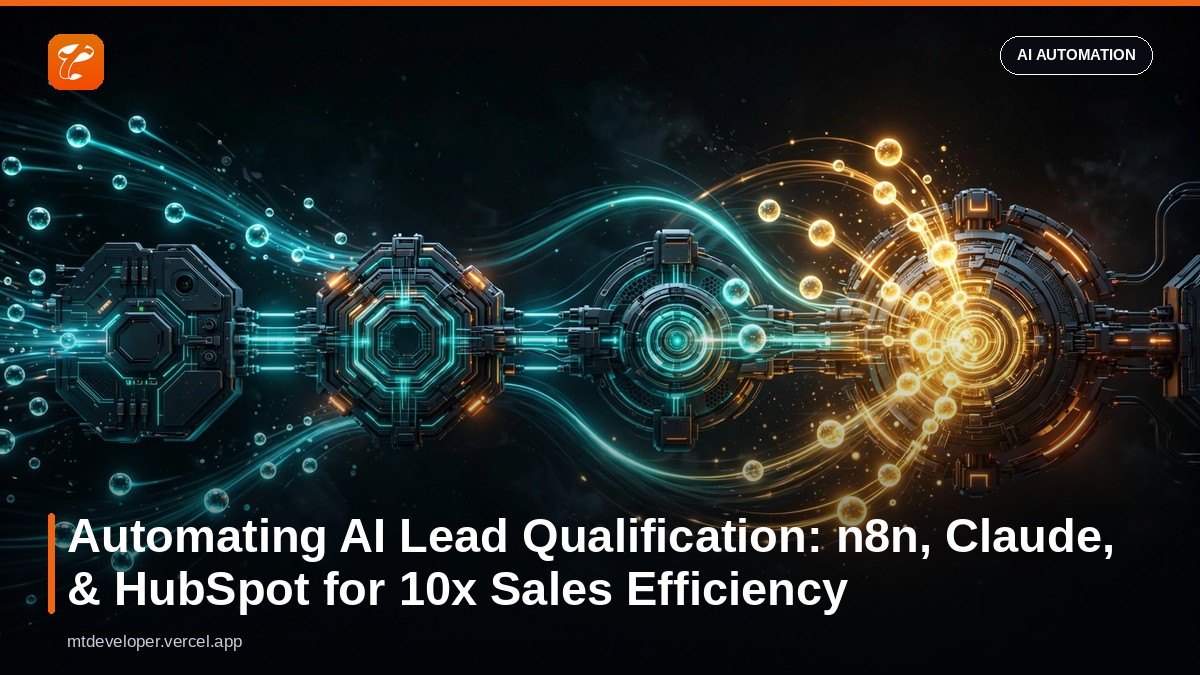
The answer lies in intelligent automation: leveraging AI to autonomously qualify leads. We can build a powerful, flexible, and scalable system by combining a robust workflow automation platform like n8n with an advanced large language model (LLM) such as Claude 3 (or OpenAI's GPT-4) and a leading CRM like HubSpot. This architecture transforms manual, reactive lead qualification into a proactive, real-time, and data-driven process. Our proposed solution concept orchestrates a workflow where new lead data, regardless of its source (website form, landing page, third-party integration), triggers an automated sequence. n8n acts as the central nervous system, capturing the lead, enriching its data, and intelligently dispatching it to an AI for sophisticated qualification. The LLM, pre-trained and fine-tuned with specific business criteria, assesses the lead's potential and returns a structured output. Based on this AI-driven verdict, n8n then performs conditional actions, such as updating the CRM, assigning the lead to a sales rep, or initiating a targeted nurturing sequence. Architectural Flow:
- Lead Capture: A new lead submits a form on your website, a landing page, or enters the system via another webhook-enabled service.
- n8n Webhook Trigger: The incoming lead data (name, email, company, message, etc.) is captured by an n8n webhook.
- Data Enrichment (Optional): n8n can enrich lead data by querying external APIs (e.g., Clearbit for company details, hunter.io for email verification).
- AI Qualification (Claude/OpenAI): n8n sends relevant lead data to the chosen LLM via an HTTP Request node. The AI evaluates the lead against predefined qualification criteria (e.g., industry fit, company size, expressed pain points, budget indicators).
- AI Response Parsing: A Function node in n8n parses the structured JSON response from the LLM, extracting qualification status, reason, and score.
- Conditional Logic: An IF node evaluates the AI's qualification status. Qualified leads follow one path, while unqualified leads take another.
- CRM Update (HubSpot): For qualified leads, n8n uses a HubSpot node (or a generic HTTP Request to any CRM API) to create or update a contact, assign it to the appropriate sales pipeline, and notify the sales team. For unqualified leads, n8n might log them for future nurturing or a different follow-up strategy.
This architecture ensures that only high-potential leads reach your sales team, maximizing their efficiency and greatly accelerating your sales cycle.
Step-by-Step Implementation
Building this autonomous lead qualification workflow with n8n, Claude, and HubSpot involves a few key steps. This guide assumes you have an n8n instance running (either self-hosted or cloud), an API key for Claude (or OpenAI), and a HubSpot account. 1. Setting Up the n8n Workflow Trigger (Webhook) First, open your n8n instance and create a new workflow. Add a 'Webhook' node as your starting point. This node will listen for incoming lead data.
- Mode:
POST - Path: Choose a unique path (e.g.,
new-lead-webhook).
Copy the provided webhook URL. This is where your lead generation forms or other systems will send data. For testing, you can send a POST request to this URL with sample lead data (e.g., {"name": "Alice Smith", "email": "alice@example.com", "company": "InnovateCorp", "message": "Interested in enterprise AI solutions for data analytics and cost reduction."}). 2. Integrating AI for Qualification (Claude 3) Next, we'll add an 'HTTP Request' node to send the lead data to the Claude API for qualification.
- Authentication: Create a new credential for 'Header Auth' in n8n. Set the
Header Nametox-api-keyandHeader Valueto your Claude API key. Add another headeranthropic-betawith valuemessages-2023-12-15. - Method:
POST - URL:
https://api.anthropic.com/v1/messages - Body Parameters (JSON): Construct the payload for Claude. This is where prompt engineering is crucial. You want to instruct the AI clearly on how to qualify a lead and what output format to use. Asking for a JSON output simplifies parsing.
{
  "model": "claude-3-opus-20240229",
  "max_tokens": 200,
  "messages": [
    {
      "role": "user",
      "content": "As an expert B2B SaaS sales qualifier, analyze the following lead data to determine if they are a highly qualified prospect for enterprise AI automation solutions. Consider company size, expressed needs, and seniority. Return a JSON object with 'qualified' (boolean: true/false), 'reason' (string: concise explanation for qualification or disqualification), and 'score' (integer: 1-10, where 10 is highest qualification). If no clear company size or role is provided, assume lower qualification unless message implies strong intent.

Lead Details:
Name: {{ $json.name }}
Email: {{ $json.email }}
Company: {{ $json.company }}
Message: {{ $json.message }}"
    }
  ]
}
3. Parsing the AI's Response Claude will return a JSON object nested within its response. We need a 'Function' node to extract the qualification details.
- Add a 'Function' node after the 'HTTP Request' node.
- Function Code:
const aiRawResponse = $json.response.data.content[0].text;
let aiQualification = { qualified: false, reason: "AI response parse error or invalid format.", score: 0 };

try {
  const parsedResponse = JSON.parse(aiRawResponse);
  if (typeof parsedResponse.qualified === 'boolean' &&
      typeof parsedResponse.reason === 'string' &&
      typeof parsedResponse.score === 'number') {
    aiQualification = parsedResponse;
  } else {
    // Log detailed error if AI output structure is unexpected
    console.error('AI returned unexpected JSON structure:', aiRawResponse);
  }
} catch (e) {
  console.error('Failed to parse AI response JSON:', e.message);
}

// Combine original lead data with AI qualification results
return [{
  json: {
    ...$json.webhook.data,
    qualified: aiQualification.qualified,
    qualificationReason: aiQualification.reason,
    qualificationScore: aiQualification.score
  }
}];
4. Implementing Conditional Logic Now, use an 'IF' node to branch your workflow based on the qualified status from the AI.
- Condition:
{{ $json.qualified }}is true.
This will create two branches: one for qualified leads and one for unqualified. 5. Updating HubSpot (CRM) & Automation
- Branch 1 (Qualified Leads):
- Add a 'HubSpot' node.
- Operation:
Contact->Create or Update. - Map the lead data:
Emailto{{ $json.email }},First Nameto{{ $json.name }},Company Nameto{{ $json.company }}. Add custom properties forqualification_status({{ $json.qualified ? 'Qualified' : 'Unqualified' }}),qualification_reason({{ $json.qualificationReason }}), andqualification_score({{ $json.qualificationScore }}). - Optionally, add another 'HubSpot' node to
Associate to DealorCreate Taskfor a sales rep, ensuring immediate follow-up. - Optionally, add a 'Send Email' node (e.g., using SendGrid) to notify the sales team or send a personalized initial message to the lead.
- Branch 2 (Unqualified Leads):
- You might still want to log these in HubSpot, perhaps with a different lifecycle stage or as a lower-priority contact. Use another 'HubSpot' node.
- Alternatively, you could send them down an automated nurturing path using an 'Email' node (e.g., SendGrid) for drip campaigns, or simply log them in a spreadsheet for later review.
Optimization & Best Practices
To ensure your AI-powered lead qualification system performs optimally and provides maximum ROI, consider these best practices:
- Continuous Prompt Engineering: The quality of your AI's qualification depends heavily on the prompt. Iteratively refine your prompt with specific examples of qualified and unqualified leads, precise criteria, and explicit instructions for the desired JSON output. A well-crafted prompt can significantly reduce hallucination and improve accuracy.
- Robust Error Handling: Implement
Try/Catchblocks within n8n workflows, especially around API calls to the LLM and CRM. Log errors to a dedicated service (e.g., Slack, Sentry) and configure alerts for critical failures. This ensures you're aware of any disruptions and can address them promptly, preventing lead loss. - API Key Security: Never hardcode API keys directly in your n8n nodes. Always use n8n's secure 'Credentials' feature to store and manage sensitive information like API keys for Claude and HubSpot. Regularly rotate these keys.
- Rate Limiting and Retries: Be mindful of the API rate limits imposed by LLM providers (Claude, OpenAI) and your CRM. Implement retry logic with exponential backoff for HTTP requests in n8n to handle transient rate limit errors gracefully, preventing workflow failures during peak load.
- Data Validation and Sanitization: Before sending lead data to the AI or CRM, validate and sanitize it. Ensure required fields are present and format data correctly to prevent API errors and ensure data integrity. Use n8n's 'Set' and 'Merge' nodes for data transformation.
- Monitoring and Analytics: Monitor your n8n workflow execution logs for performance bottlenecks or frequent failures. Track the AI's qualification accuracy over time. Integrate with analytics tools to understand the conversion rates of AI-qualified vs. manually-qualified leads, providing continuous feedback for improvement.
- Human-in-the-Loop (Optional): For critical leads or during initial rollout, consider adding a human review step for leads that the AI scores ambiguously or for high-value prospects. This can be achieved by sending a notification to a human agent in n8n for approval before the CRM update.
Business Impact & ROI
Implementing an AI-driven lead qualification system delivers tangible business impact and a significant return on investment:
- 10x Sales Efficiency: By offloading the initial, time-consuming task of qualification to AI, sales teams can focus solely on engaging high-potential prospects. This dramatically reduces the time spent on unqualified leads, allowing reps to close more deals faster.
- Faster Lead Response Times: Qualified leads are identified and routed to the appropriate sales representative within seconds, not hours or days. This immediacy is critical for capturing interest while it's hot, significantly increasing the likelihood of conversion.
- Higher Conversion Rates: Sales efforts are precisely targeted, leading to more relevant conversations and higher conversion rates across the sales funnel. AI ensures that the right message reaches the right prospect at the optimal time.
- Reduced Operational Costs: Automating qualification reduces the need for extensive manual labor, freeing up SDRs to focus on more strategic, human-centric activities like building relationships and nurturing complex accounts. This directly translates into lower overhead and improved resource utilization.
- Scalability: The system can effortlessly handle increasing volumes of leads without a linear increase in human resources. As your business grows, your lead qualification scales seamlessly, maintaining efficiency.
- Data-Driven Insights: The AI's qualification scores and reasons provide valuable, quantifiable insights into your lead quality and the effectiveness of your lead generation efforts. This data can be used to refine marketing strategies and improve the overall sales process.
- Improved Employee Morale: Sales teams are empowered to perform at their best, engaging in more rewarding interactions with genuinely interested prospects, leading to higher job satisfaction and lower churn.
Conclusion
The era of manual, inefficient lead qualification is rapidly fading. By strategically combining n8n's robust workflow orchestration capabilities with the advanced intelligence of large language models like Claude 3 and the power of CRM platforms like HubSpot, businesses can build autonomous systems that fundamentally transform their sales operations. This not only resolves the critical problem of wasted resources and lost opportunities but also ushers in a new era of unprecedented sales efficiency, higher conversion rates, and a significantly improved bottom line. The path to 10x sales efficiency is no longer a pipe dream but a practical, implementable reality for any forward-thinking organization ready to embrace AI automation. Embrace this shift, and empower your sales team to focus on what they do best: building relationships and closing deals, while AI handles the heavy lifting of intelligent qualification. This is not just an optimization; it's a strategic imperative for competitive advantage in the modern market.