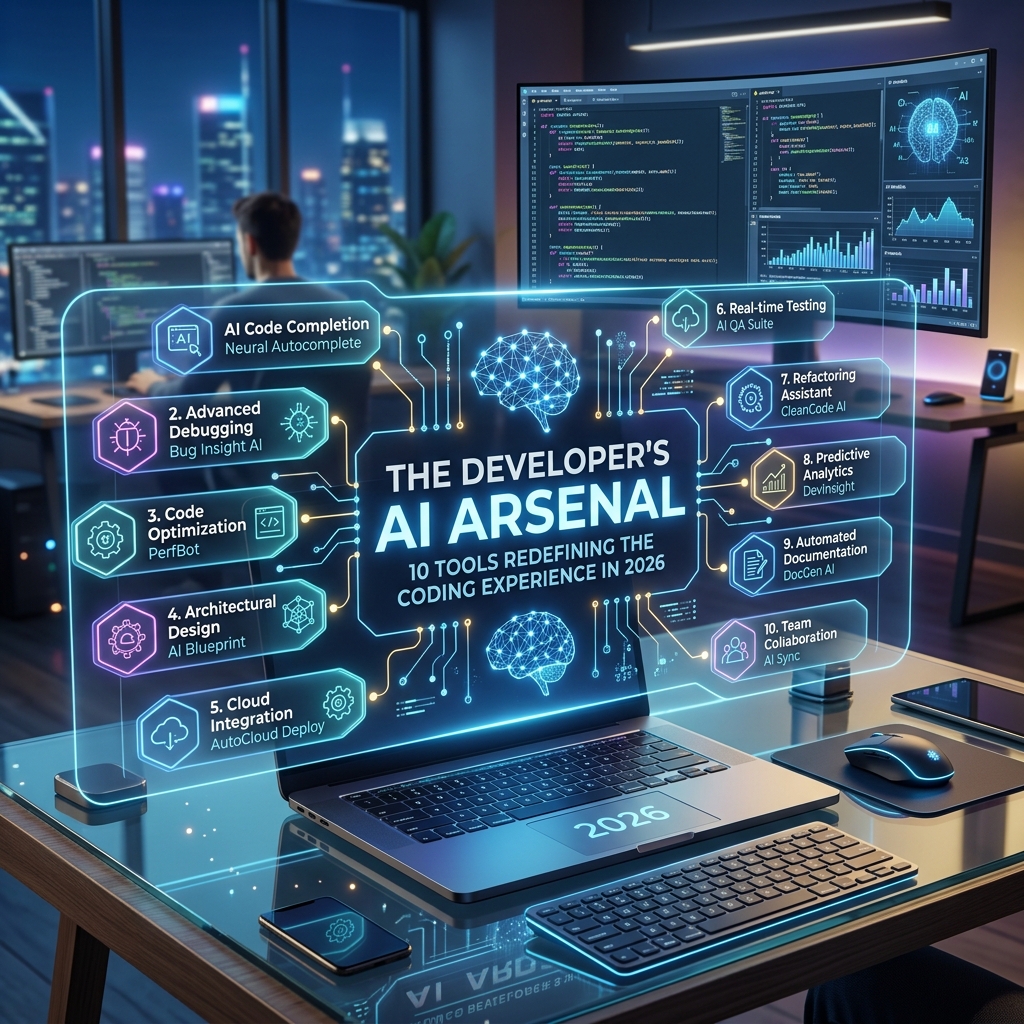
The developer landscape in 2026 is unrecognizable from what it was just a few years ago. We have fully evolved beyond standard code-completion inline autocompletes into an ecosystem dominated by autonomous programming assistants, specialized model interfaces, and intelligent runtime debugging layers. For the modern engineer, the goal is no longer just typing code faster—it is orchestrating AI-driven workflows to ship premium features in record time. In this comprehensive review, we analyze the absolute top-tier AI tools that every developer must integrate into their toolkit in 2026 to remain highly productive and competitive.
1. Autonomous Development Frameworks
While standard code copilots operate directly inside the IDE to suggest lines of code, the real revolution of 2026 is autonomous development frameworks. These tools operate as virtual junior developers. They connect directly to your terminal, local filesystem, and version control system to execute complex instructions autonomously.
- Google Antigravity SDK: The leading framework for designing, implementing, and orchestrating multi-agent development pipelines. Antigravity allows developers to define specialized agents (e.g. database debuggers, SEO optimizers, frontend refactorers) that collaborate seamlessly on a single project, verifying their own work using internal test runners.
- Devin and its Open-Source Successors: Autonomous agents that read pull requests, reproduce issues in sandboxed Docker containers, and recursively debug code until they pass existing CI/CD gates.
2. Advanced IDE Environments and Code Editors
Traditional text editors have evolved into intelligent pair-programming platforms. The top IDEs of 2026 are built entirely around the conversational and contextual understanding of models:
Editors like Cursor and VS Code Insider extensions now feature deep codebase indexing (using high-dimensional vector embeddings). When you ask a question or issue an edit request, the IDE does not just look at the open file—it maps out dependencies across your entire repository, references related components, and applies code refactorings across multiple, non-adjacent lines of code with pixel-perfect accuracy.
3. Intelligent Terminals and Command Line Interfaces
Wrestling with complex shell commands, Kubernetes manifests, or obscure Git options is a thing of the past. Modern developer setups now feature AI-native terminals that translate natural language directly into safe shell executions:
# Inside an AI-native shell terminal in 2026
$ ask-shell "find all unused PNG files under public/ and list their sizes"
> Executing: find public -name "*.png" -exec ls -lh {} + | awk \'{print $9, $5}\'
# [Agent] Found 14 unused files. Would you like me to delete them? (Y/n)
Platforms like Warp and Fig have evolved to incorporate agentic assistants that troubleshoot build failures directly inside the terminal panel, suggesting immediate dependency adjustments or patch solutions.
4. Automated Test Suites and Testing Agents
Writing tests has historically been the most tedious part of the development lifecycle. In 2026, AI-driven testing tools have made manually writing boilerplate unit tests obsolete:
- Predictive Test Generation: Tools analyze your implementation patterns, identify potential logical edge cases, and automatically generate comprehensive test suites (using Jest, PyTest, or Flutter Test suites) that cover extreme input parameters.
- Visual Regression Auditing: AI agents automate browser-driven visual testing by rendering pages, analyzing screenshot layouts for alignment drift or color contrast issues, and automatically creating visual audit tickets before deployment.
5. AI-Powered API Testing and Mocking Tools
For full-stack developers, keeping frontend mock data aligned with evolving backend schemas is a constant struggle. Modern AI tools intercept API schemas and automatically generate dynamic, context-aware mock servers that return realistic data payloads, accelerating parallel frontend-backend development.
Best Practices: Integrating AI Tools Into Your Workflow
To successfully integrate these tools without compromising codebase security or code quality, developers should adhere to the following best practices:
- Always Require Human Review (Human-in-the-Loop): No matter how sophisticated an autonomous agent is, it lacks product context. Maintain strong PR boundaries where every AI-generated commit is reviewed by a human team member.
- Provide Fast Test Suites: AI agents thrive on instant feedback. Keep your local unit and integration tests incredibly fast so agents can execute self-correction cycles efficiently.
- Secure API Keys and Limits: Set up secure rate-limiting and budget controls on your LLM API tokens. Use sandboxed local environment variables rather than hardcoding credentials inside your developer configuration.
- Maintain a Structured Design System: When using AI tools to build user interfaces, a structured design system with consistent tokens ensures that the generated components look premium, responsive, and aligned with your branding.
Conclusion
The transition to AI-assisted and autonomous development is not about replacing human engineers—it is about supercharging our productivity. The tools available in 2026 allow us to offload repetitive boilerplate, syntax translation, and regression testing, freeing up our mental energy to focus on architectural design, user experience, and high-impact problem solving. By incorporating these top AI tools into your daily workflow, you step up from a standard coder to an elite software orchestrator, leading teams of virtual assistants to ship state-of-the-art applications at a speed that was once unimaginable.