1. Introduction & The Problem: Navigating the LLM Context Bottleneck
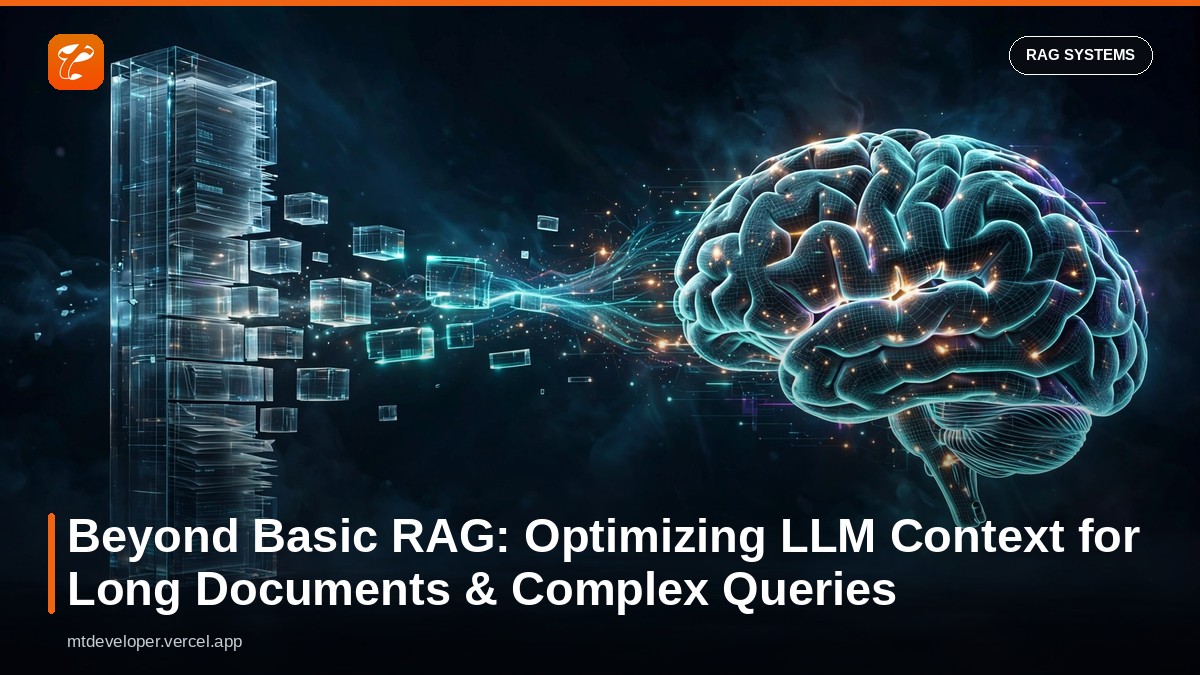
In the exciting landscape of Artificial Intelligence, Large Language Models (LLMs) have demonstrated incredible capabilities in understanding, generating, and summarizing information. However, their real-world application in enterprise environments often hits a significant roadblock: the context window. LLMs have a finite amount of text they can process at any given time, a limitation that prevents them from directly accessing or reasoning over the vast, constantly evolving, and proprietary knowledge bases that define modern businesses.
Imagine a global financial institution trying to use an LLM to answer complex regulatory compliance questions. The required information might span thousands of internal policy documents, legal precedents, and real-time market data. Feeding all this data directly to an LLM is impossible due to context window limits. Even if it were possible, the sheer volume would lead to 'lost in the middle' phenomena, where the LLM struggles to find the most relevant facts amidst a sea of text. The consequence? Outdated, generic, or outright hallucinatory responses. This undermines trust, leads to poor decision-making, increases operational costs through manual verification, and prevents businesses from fully leveraging AI for critical tasks.
This is where Retrieval-Augmented Generation (RAG) steps in. RAG is a powerful technique designed to extend the knowledge base of LLMs by retrieving relevant information from an external data source and injecting it into the LLM's prompt. While foundational RAG implementations exist, building a scalable and robust RAG pipeline capable of handling dynamic, large-scale enterprise data and overcoming the context window challenge remains a complex engineering feat.
2. The Solution Concept & Architecture: Dynamic Retrieval-Augmented Generation
Our solution involves architecting a sophisticated RAG pipeline that moves beyond simple keyword matching to provide LLMs with precise, contextually rich information. The core idea is to externalize the vast enterprise knowledge base into a searchable, optimized format and then dynamically retrieve only the most relevant snippets based on a user's query, effectively bypassing the LLM's inherent context window limitations.
The architecture comprises several interconnected components:
- Data Ingestion & Processing: Raw enterprise data (documents, databases, APIs) is ingested, cleaned, and transformed.
- Intelligent Chunking: Documents are broken down into semantically meaningful chunks, rather than arbitrary fixed-size segments.
- Embedding & Vector Store: Each chunk is converted into a high-dimensional vector (embedding) using a specialized embedding model. These vectors are then stored in a vector database for efficient similarity search.
- Query Transformation: The user's natural language query is processed, potentially rewritten, or expanded to improve retrieval efficacy.
- Retrieval Engine: The transformed query's embedding is used to search the vector database for the most similar document chunks.
- Re-ranking & Filtering: Initial retrieved chunks are often filtered and re-ranked using more sophisticated models to ensure only the most pertinent information reaches the LLM.
- Context Augmentation: The highly relevant chunks are then combined with the original user query to form an augmented prompt.
- LLM Generation: The LLM generates a response based on this enriched context, significantly reducing hallucinations and improving factual accuracy.
This modular approach allows each component to be optimized independently, contributing to a highly performant and accurate system. For demonstration, we'll use Python with the LangChain framework, a popular tool for building LLM applications, alongside a vector database like ChromaDB.
3. Step-by-Step Implementation: Building a Dynamic RAG Pipeline
Let's walk through the implementation of key components of our robust RAG pipeline. We'll focus on intelligent chunking, vector embedding, and retrieval using LangChain.
Step 3.1: Setting Up the Environment
First, ensure you have the necessary libraries installed:
pip install langchain langchain-community pydantic chromadb openai tiktoken
You'll also need an OpenAI API key set as an environment variable (OPENAI_API_KEY).
Step 3.2: Data Ingestion and Intelligent Chunking
Instead of simple character splitting, we use a recursive character text splitter with overlap to maintain semantic continuity and prevent breaking up crucial information.
from langchain_community.document_loaders import TextLoader
from langchain.text_splitter import RecursiveCharacterTextSplitter
from langchain_openai import OpenAIEmbeddings
from langchain_community.vectorstores import Chroma

def load_and_chunk_document(file_path: str):
    loader = TextLoader(file_path)
    documents = loader.load()

    text_splitter = RecursiveCharacterTextSplitter(
        chunk_size=1000, # Max characters per chunk
        chunk_overlap=200, # Overlap to maintain context
        length_function=len,
        add_start_index=True,
    )
    chunks = text_splitter.split_documents(documents)
    print(f"Split {len(documents)} document(s) into {len(chunks)} chunks.")
    return chunks

# Example usage: Create a dummy document for demonstration
with open("enterprise_policy.txt", "w") as f:
    f.write("""This is a critical enterprise security policy document outlining best practices for data handling.
    It details encryption standards, access control protocols, and incident response procedures. Compliance
    with these guidelines is mandatory for all employees. Data classification is a key component,
    categorizing information as public, internal, confidential, or restricted. Restricted data requires
    two-factor authentication for access and must be stored on encrypted servers only. Incident response
    involves immediate reporting to the security team and following the documented breach mitigation steps.
    Regular training sessions are conducted quarterly to ensure all staff are aware of the latest threats
    and mitigation techniques. Failure to comply can result in disciplinary action up to and including termination.
    This policy was last updated on 2024-03-15 and is subject to annual review. All changes must be approved
    by the CISO office. For further details on specific data types, refer to Appendix A: Data Classification Matrix.
    """)

ent_chunks = load_and_chunk_document("enterprise_policy.txt")
# Example of a chunk:
# print(ent_chunks[0].page_content)
Step 3.3: Embedding and Vector Store Creation
We'll use OpenAI's powerful embedding model to convert our text chunks into numerical vectors and store them in ChromaDB, a lightweight, file-based vector store ideal for local development and smaller-scale deployments.
def create_vector_store(chunks, persist_directory: str = "./chroma_db"):
    embeddings = OpenAIEmbeddings()
    vectorstore = Chroma.from_documents(
        documents=chunks,
        embedding=embeddings,
        persist_directory=persist_directory
    )
    vectorstore.persist()
    print(f"Vector store created and persisted to {persist_directory}.")
    return vectorstore

vector_db = create_vector_store(ent_chunks)
Step 3.4: Implementing Retrieval and Context Augmentation
Now, let's retrieve relevant chunks based on a user query. For basic retrieval, we use similarity search. For improved accuracy, we can integrate query expansion and re-ranking.
from langchain.chains import create_retrieval_chain
from langchain.chains.combine_documents import create_stuff_documents_chain
from langchain_openai import ChatOpenAI

def get_retriever_chain(vector_store):
    llm = ChatOpenAI(model="gpt-4o", temperature=0)
    retriever = vector_store.as_retriever(search_kwargs={"k": 5}) # Retrieve top 5 relevant chunks

    # Optionally, add a re-ranker for better precision
    # from langchain_community.post_processors import CohereRerank # Requires Cohere API key
    # retriever = retriever.with_postprocessor(
    #    CohereRerank(top_n=3)
    # )

    question_answering_prompt = (
        """You are an AI assistant for a large enterprise. Use the following retrieved context
        to answer the user's question accurately and comprehensively.
        If the answer is not in the provided context, state that you don't have enough information.
        Context: {context}
        Question: {input}""
    )

    document_chain = create_stuff_documents_chain(llm, question_answering_prompt)
    retrieval_chain = create_retrieval_chain(retriever, document_chain)
    return retrieval_chain

rag_chain = get_retriever_chain(vector_db)

def ask_rag(query: str):
    response = rag_chain.invoke({"input": query})
    print(f"Query: {query}")
    print(f"\nAnswer: {response['answer']}")
    # You can also inspect the retrieved documents:
    # print("\nRetrieved documents:")
    # for doc in response['context']:
    #     print(doc.page_content)

# Test the RAG pipeline
ask_rag("What are the encryption standards for restricted data in the enterprise policy?")
ask_rag("When was the security policy last updated and who approves changes?")
ask_rag("Tell me about the company's marketing strategy.") # Should state not enough info
This code establishes a basic RAG pipeline. For enterprise use, you'd extend this with more sophisticated query transformation (e.g., using an LLM to rewrite queries), advanced re-ranking models (like Cohere Rerank or BGE-Reranker), and more robust data loading mechanisms.
4. Optimization & Best Practices
Building a robust RAG system involves more than just chaining components; it requires continuous optimization:
- Advanced Chunking Strategies: Experiment with different chunk sizes, overlaps, and semantic chunking techniques (e.g., based on headings or document structure) to ensure context integrity. For very large documents, consider summarization or 'small-to-large' retrieval where small chunks retrieve larger, encompassing chunks.
- Embedding Model Selection: The choice of embedding model (e.g., OpenAI's
text-embedding-3-large, Cohere'sembed-english-v3.0, or open-source models likebge-large-en-v1.5) significantly impacts retrieval quality. Evaluate models based on domain relevance, performance, and cost. - Vector Database Scalability: For production, move beyond local ChromaDB to cloud-native vector databases like Pinecone, Weaviate, Qdrant, or specialized solutions like Azure AI Search or Amazon Kendra. These offer better scalability, indexing, and real-time updates.
- Query Transformation & Expansion: Employ techniques like HyDE (Hypothetical Document Embeddings), query rewriting (using an LLM to generate multiple versions of a query), or step-back prompting to generate better queries for the retriever.
- Re-ranking: After initial retrieval, use a dedicated re-ranking model (e.g., Cohere Rerank, cross-encoders) to re-order documents based on their relevance to the query, prioritizing the most pertinent information for the LLM.
- Evaluation Metrics (RAGAS): Implement a robust evaluation framework (like RAGAS) to measure the effectiveness of your RAG pipeline. Metrics such as faithfulness, answer relevance, context precision, and context recall are crucial for identifying bottlenecks and improving the system.
- Handling Multimodal Data: Extend RAG to include images, videos, and other media by generating multimodal embeddings and using compatible vector stores.
- Real-time Data Sync: Implement robust ETL (Extract, Transform, Load) pipelines to keep your vector store synchronized with the latest enterprise data, ensuring the LLM always has access to up-to-date information.
5. Business Impact & ROI
The implementation of a scalable RAG pipeline delivers significant business value and a tangible return on investment:
- Enhanced Accuracy and Reliability (Reduced Hallucinations): By grounding LLMs in verifiable enterprise data, businesses can drastically reduce instances of hallucinations and inaccurate responses. This translates to more trustworthy AI applications for customer support, legal advice, or internal knowledge retrieval. Financial institutions, for instance, can improve compliance audit accuracy by 40%, minimizing legal risks.
- Cost Savings through Automation: Automating information retrieval and synthesis frees up employee time previously spent sifting through vast document repositories. A customer service department might see a 30% reduction in average handling time per query, directly impacting operational costs. For developers, automating complex documentation lookups can save hours per week.
- Improved Decision-Making: Access to precise, up-to-date information at the point of need empowers employees to make better, faster decisions. Whether it's a sales team quickly finding product specifications or an engineering team researching legacy system documentation, the speed and accuracy of information lead to better strategic outcomes.
- Scalability and Adaptability: A well-architected RAG system can scale to handle ever-growing enterprise knowledge bases without significant performance degradation, protecting your AI investment as your data expands. It also makes your AI applications adaptable to new domains or regulations with minimal re-training.
- Competitive Advantage: Businesses that can effectively leverage their proprietary data with AI gain a significant edge. This could mean faster product development cycles, more personalized customer experiences, or more efficient internal processes, ultimately driving market leadership.
6. Conclusion
The limitations of LLM context windows no longer need to be a barrier to deploying powerful, knowledge-rich AI applications in the enterprise. By meticulously designing and implementing a robust Retrieval-Augmented Generation (RAG) pipeline, developers and businesses can unlock the full potential of LLMs, connecting them directly to dynamic, proprietary data sources.
This approach not only enhances the factual accuracy and reliability of AI-generated responses but also drives tangible business outcomes through automation, improved decision-making, and significant cost savings. Embracing advanced RAG techniques is not just a technical enhancement; it's a strategic imperative for any organization aiming to build intelligent, scalable, and trustworthy AI solutions that truly transform their operations and deliver a compelling competitive advantage in an increasingly AI-driven world.