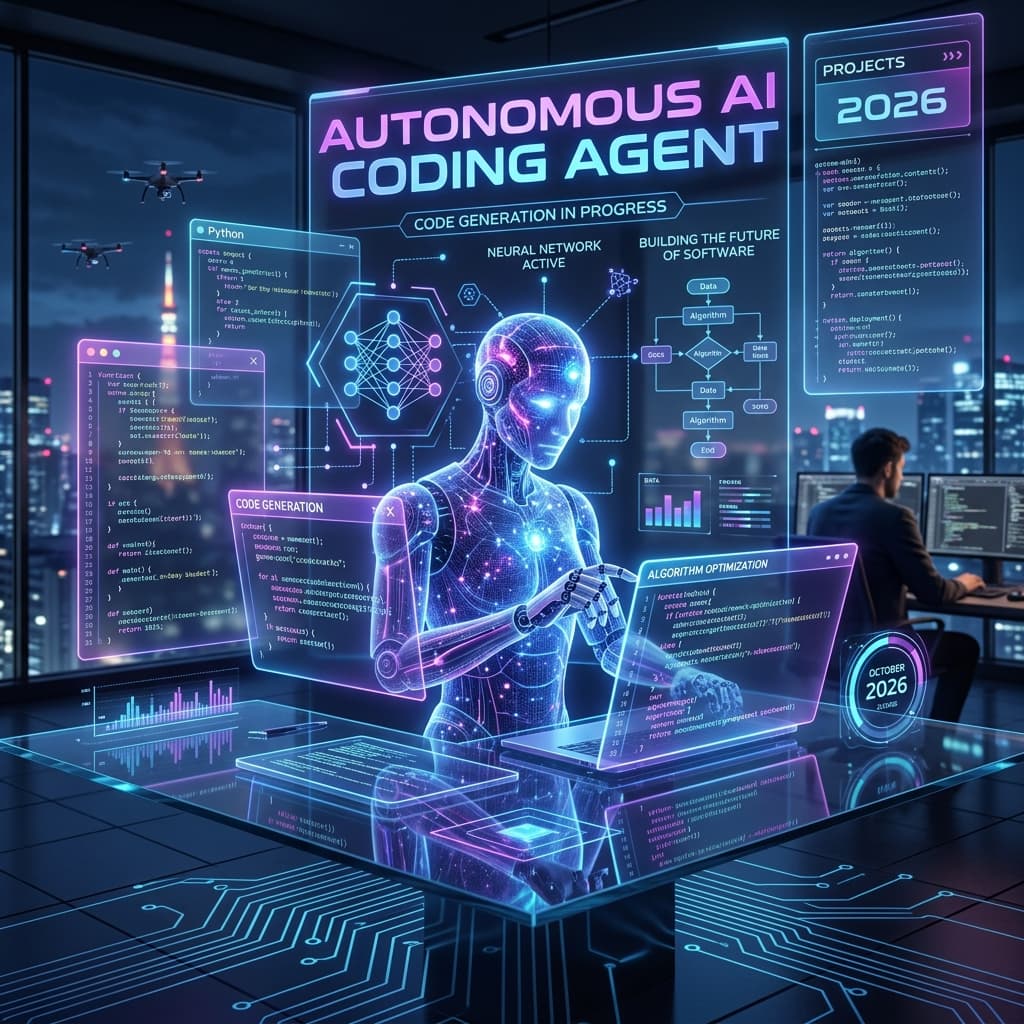
The transition of software development tools over the last half-decade has been nothing short of breath-taking. We started the decade with basic IDE tab-completion, transitioned through the revolutionary era of line-by-line copilot assistants, and have now arrived at the frontier of 2026: the era of Autonomous AI Coding Agents. These are not merely predictive typing widgets; they are agentic systems capable of planning, reading codebases, utilizing terminal tools, executing test suites, and self-correcting their own bugs. For developers, freelancers, and tech enthusiasts, this shift represents a profound evolution in how we conceive, write, and maintain software.
From Autocomplete to Autonomy
To understand the depth of this change, we have to look under the hood at how these systems operate. Traditional coding assistants were essentially statistical mimics, predicting the next few tokens based on the immediate file buffer. An autonomous AI coding agent, by contrast, operates on an agentic loop. It functions as a reasoning engine powered by a Large Language Model, equipped with specialized tools to interact with the physical or virtual workspace.
A typical agentic execution loop follows a strict cognitive architecture:
- Perception: The agent reads the prompt and indexes the codebase, building a high-fidelity conceptual map of the project files, dependencies, and data flow.
- Planning: Rather than writing code immediately, it outlines an implementation plan, breaking down a complex prompt into sequential, atomic milestones.
- Tool Execution: Equipped with file read/write APIs, terminal access, and command-line execution tools, the agent navigates directories, creates or modifies files, and runs builds.
- Feedback & Self-Correction: If a build fails or a test fails, the agent doesn't stop. It parses the compiler error or stack trace, formulates a debugging hypothesis, and refactors its own solution until the build succeeds.
The Anatomy of Agentic Core Architecture
Building software with agents relies on several advanced concepts that have matured rapidly by 2026:
1. Abstract Syntax Tree (AST) & Semantic Indexing
An agent does not simply read text files. It relies on advanced code-understanding pipelines that parse code into Abstract Syntax Trees (ASTs). This allows the agent to build a semantic graph of classes, functions, and database schemas. Tools like Graphify index codebases, enabling the agent to execute graph-based queries like "Find all controllers that call the sendEmail helper" in a fraction of a second.
2. Sandbox Isolation
Running code autonomously requires a secure environment. Agents execute builds, run shell commands, and interact with npm packages inside Docker containers or secure sandboxed environments. This ensures that a malicious dependency or buggy infinite loop cannot compromise the host operating system.
3. Tool Call Orchestration
The engine coordinates tool use using JSON schemas. The agent decides when to invoke a web search, query a database model, use a browser tool (via Chrome DevTools MCP), or execute a terminal command. By chaining these tools, the agent achieves what was once considered impossible: end-to-end task completion.
Real-World Case Study: Automated API Migrations
Consider a practical engineering task that developers frequently dread: migrating a backend service from Express to Fastify, or upgrading a frontend component library to a new major version. Previously, this required a developer to spend days manually rewriting routing middleware, updating imports, and debugging runtime errors.
In 2026, the workflow is automated:
- The developer provides a high-level goal:
"Migrate the blogs API routes from Express to Fastify and verify all tests pass." - The coding agent reads the existing Express routes, maps the controllers, and creates a fastify-compatible route architecture.
- It edits the code, updates the package dependencies, and triggers the installer in the sandbox.
- It runs the test suite. Finding three broken authentication middleware tests, it reads the test output, corrects the Fastify request decoration headers, and reruns the tests.
- Within four minutes, the migration is complete, tested, and ready for human review via a Git pull request.
This is not science fiction — it is the daily operational reality of modern software teams in 2026.
Best Practices for Developer-Agent Synergy
As the developer’s role shifts from writing syntax to directing systems, successful engineers are adopting a set of strict guidelines to maximize the value of their agentic peers:
Write Explicit System Prompts & Boundaries
Just like a human engineer, an AI agent thrives on clarity. Provide explicit context about the desired design patterns, architectural layers, and performance limits. If your backend relies on the Duck pattern or service layers, state this clearly in your instructions.
Isolate Credentials and Secrets
Never commit raw API keys, passwords, or Mongo connection strings to code files that an agent reads or writes. Ensure that all credentials are strictly loaded via process.env or secure vault services. A well-behaved agent will always verify that .env files are in the .gitignore before performing Git operations.
Maintain Human Supervision & Strict Code Reviews
AI agents are incredibly fast, but they lack human business intuition. Treat an agent's code as you would a pull request from a highly productive junior engineer. Always review the diffs, run sanity checks, and verify that edge cases (like authentication verification and input validation) are robustly handled.
The Future Outlook: The Rise of the Systems Architect
What does this mean for the career of a software developer in 2026? The panic that AI would replace programmers has subsided, replaced by a realization that AI has elevated the profession. Developers are no longer bottlenecked by syntax errors, boilerplate, or repetitive API migrations.
Instead, software engineers are becoming Systems Architects and Product Directors. We spend our time designing resilient data models, crafting gorgeous and intuitive user experiences, managing state logic, and defining the system requirements that agents execute. We are now multipliers, capable of launching complex full-stack applications in days rather than months.
Conclusion
Autonomous AI coding agents are here to stay, and they are transforming the software engineering landscape. By taking over the tedious, predictable parts of development, they free us to focus on what humans do best: creative problem solving, strategic product design, and architectural innovation. The developers who thrive in 2026 are not those who resist this shift, but those who learn to orchestrate and collaborate with these powerful agentic systems.